
Durgesh Tiwari
Author
Artificial Intelligence (AI) is one of the most important technologies in the modern world. It enables machines and software to perform tasks that normally require human intelligence, such as learning, problem-solving, understanding language, and making decisions.
Today, AI is used in search engines, smartphones, online shopping platforms, healthcare systems, banking services, and many other industries. It helps automate tasks, improve efficiency, and deliver better user experiences.
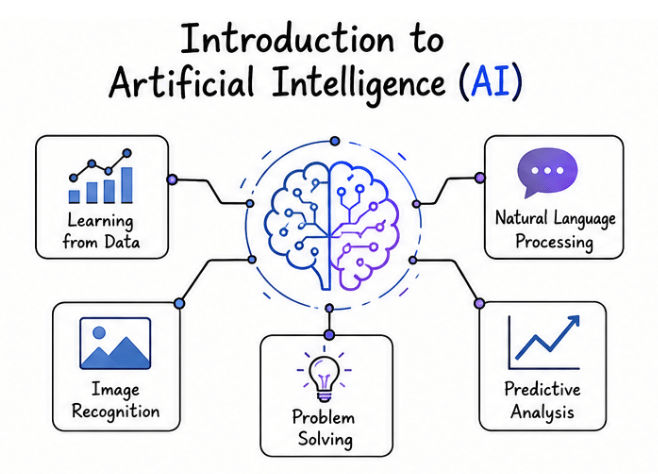
In this chapter, you will learn what Artificial Intelligence is, how it evolved over time, why it is important, and how it is used in the real world.
Artificial Intelligence (AI) is a branch of computer science that focuses on creating systems capable of performing tasks that usually require human intelligence.
Unlike traditional software that follows fixed instructions, AI systems can learn from data, recognize patterns, and make decisions based on available information.
Some common capabilities of AI include:
Learning from data
Understanding human language
Recognizing images and objects
Solving problems
Making decisions
Predicting outcomes
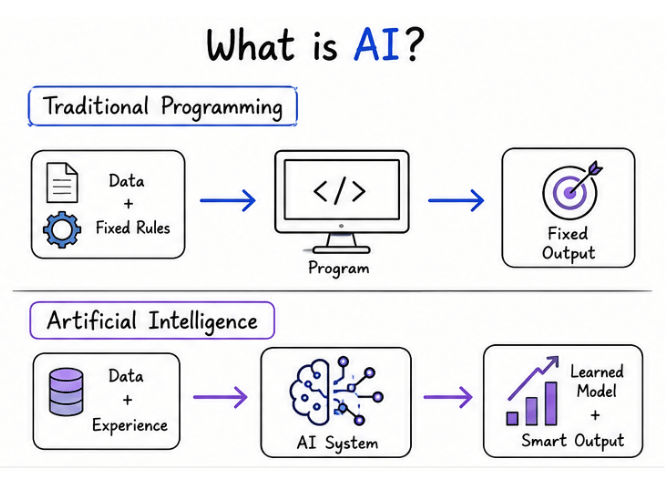
AI is designed to make technology smarter, faster, and more useful in everyday life.
Some common examples of Artificial Intelligence include:
Google Search showing relevant results
YouTube recommending videos based on interests
Voice assistants like Siri, Alexa, and Google Assistant
Smartphone face unlock systems
These applications show how AI is already helping people in their daily activities.
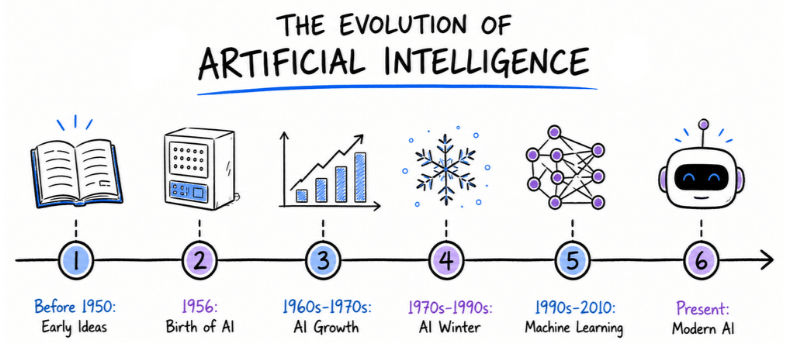
The idea of creating intelligent machines has existed for many decades. Modern AI developed through several important stages.
Researchers explored whether machines could think and solve problems like humans.
Early work focused on logic, mathematics, and reasoning.
These concepts became the foundation of Artificial Intelligence.
The term Artificial Intelligence was introduced by John McCarthy.
The Dartmouth Conference marked the beginning of AI as a formal field of study.
Researchers started developing intelligent computer systems.
Early AI programs solved logical and mathematical problems.
Systems could understand simple language and play basic games.
Limited computing power slowed progress.
AI research faced challenges due to technical limitations.
Funding and public interest declined.
Research continued despite slower progress.
Faster computers and larger datasets transformed AI development.
Machine Learning enabled systems to learn from data instead of relying only on predefined rules.
Many modern AI technologies are based on this approach.
Advances in cloud computing, big data, and Deep Learning accelerated AI growth.
AI became widely used across industries.
Applications include recommendation systems, virtual assistants, fraud detection, and medical diagnosis.
Artificial Intelligence helps individuals and organizations work more efficiently by automating tasks and supporting better decision-making.
Organizations use AI to:
Reduce operational costs
Improve customer experience
Increase productivity
Support innovation
Make data-driven decisions
As technology continues to advance, AI is playing an increasingly important role in healthcare, education, finance, transportation, and e-commerce.
Artificial Intelligence enables machines to perform tasks that normally require human intelligence. Over the years, AI has evolved from simple rule-based systems to advanced Machine Learning and Generative AI technologies.
Today, AI is used across many industries and has become an important part of modern technology and everyday life.
