
Durgesh Tiwari
Author
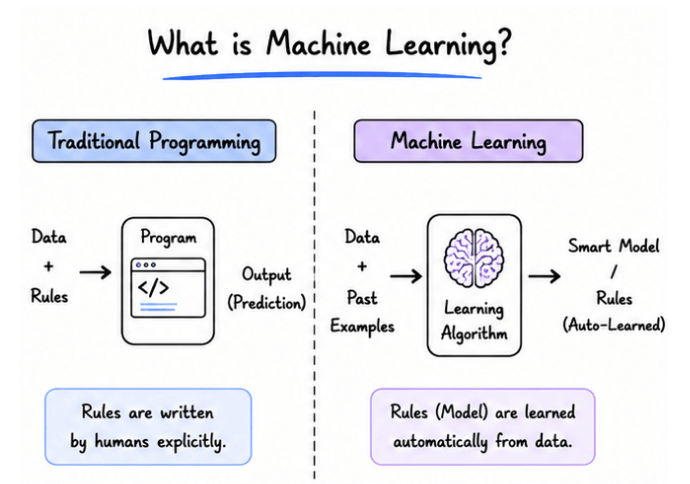
Machine Learning (ML) is a core branch of Artificial Intelligence (AI) that enables computers to learn from data and improve their performance without being explicitly programmed for every task.
Today, Machine Learning powers many technologies we use daily, including search engines, recommendation systems, online shopping platforms, banking applications, healthcare solutions, and voice assistants.
Machine Learning is a method of teaching computers to learn from data, identify patterns, and make predictions or decisions automatically.
Unlike traditional programming, where developers write rules for every situation, Machine Learning systems learn from examples and improve as more data becomes available.
YouTube video recommendations
Email spam filtering
Product recommendations on shopping websites
Traffic prediction in navigation apps
Voice assistants like Siri and Google Assistant
These applications show how Machine Learning helps make technology smarter and more personalized.
Machine Learning is commonly divided into three categories:
Supervised Learning
Unsupervised Learning
Reinforcement Learning
Each type uses a different approach to learn from data and solve problems.

Supervised Learning uses labeled data, meaning the correct answers are already available during training. The model learns the relationship between inputs and outputs and then predicts results for new data.
Example
A house price prediction system can learn from data such as location, size, and number of rooms to estimate the price of a new house.
House price prediction
Weather forecasting
Email spam detection
Medical diagnosis
Customer churn prediction
Easy to understand and train
Provides accurate predictions with quality data
Widely used in real-world applications
Requires labeled data
Data preparation can be time-consuming
Results depend heavily on data quality
Unsupervised Learning works with unlabeled data. Instead of predicting answers, the model discovers hidden patterns and relationships within the data.
Example
An online store can automatically group customers based on their shopping behavior without predefined categories.
Customer segmentation
Recommendation systems
Pattern discovery
Market analysis
Fraud detection
No labeled data required
Helps uncover hidden insights
Useful for exploring large datasets
Results can be difficult to interpret
Accuracy is harder to measure
Some discovered patterns may not be useful
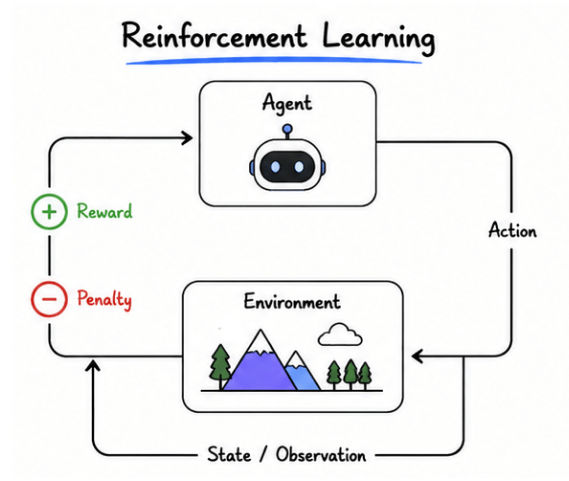
Reinforcement Learning is based on learning through rewards and penalties. The system continuously interacts with an environment and improves its decisions over time.
Example
A self-driving car learns how to navigate safely by receiving feedback from its environment and improving its actions.
Self-driving vehicles
Robotics
Game-playing AI
Traffic optimization
Autonomous systems
Learns from experience
Improves continuously over time
Suitable for complex decision-making tasks
Requires extensive training
Computationally expensive
Training can take a long time
Machine Learning enables computers to learn from data and improve their performance without explicit programming.
The three main types of Machine Learning are:
Supervised Learning
Unsupervised Learning
Reinforcement Learning
Together, these approaches form the foundation of modern AI systems and are widely used in applications ranging from recommendation engines and fraud detection to robotics and autonomous systems.
