
Durgesh Tiwari
Author
An AI Agent is more than a system that answers questions. It can understand a goal, make decisions, use tools, and complete tasks with minimal human input.
To perform these tasks efficiently, every AI agent depends on two important concepts:
AI Agent Architecture – explains how the different components of an AI agent are connected and work together.
AI Agent Lifecycle – explains the step-by-step process an AI agent follows to complete a task.
In simple words, architecture describes how an AI agent is built, while the lifecycle explains how it works from start to finish.
Understanding these concepts helps you learn how modern AI agents solve real-world problems and power intelligent AI applications.
AI Agent Architecture is the overall structure or design of an AI agent. It defines how different components such as memory, planning, reasoning, tool usage, and execution work together to achieve a user's goal.
Instead of generating a response immediately, an AI agent first understands the request, creates a plan, gathers the required information, uses external tools if needed, and then generates the final response.
Suppose you ask:
"Find the best laptop under ₹80,000 and email me the comparison."
An AI agent may perform these steps:
Understand your request
Search for suitable laptops
Compare prices and features
Prepare the comparison
Send the result through email
All these actions are possible because the AI agent follows a well-designed architecture.
In simple words, AI Agent Architecture is the blueprint that helps an AI agent understand, plan, use tools, and complete tasks efficiently.
Modern AI agents often perform complex tasks that involve planning, decision-making, and using external tools. To manage these tasks efficiently, they need a well-designed AI Agent Architecture.
For example, if you ask an AI agent to book a flight, reserve a hotel, and create a travel itinerary, it must complete multiple steps in the correct order. A proper architecture helps the agent organize this workflow and produce accurate results.
A well-designed AI Agent Architecture helps:
Organize different AI components efficiently
Handle complex and multi-step tasks
Improve planning and decision-making
Connect with APIs, tools, and external services
Increase accuracy, reliability, and scalability
Deliver faster and more consistent results
                    User
                      │
                      ▼
              User Interface
                      │
                      ▼
             Goal Understanding
                      │
                      ▼
            Planning & Reasoning
                      │
          ┌───────────┼───────────┐
          │           │           │
          ▼           ▼           ▼
       Memory       Tools     Knowledge
                     │            Base
                     ▼
          APIs • Search • Database
                     │
                     ▼
              Action Execution
                     │
                     ▼
          Monitoring & Feedback
                     │
                     ▼
            Response Generation
                     │
                     ▼
                    User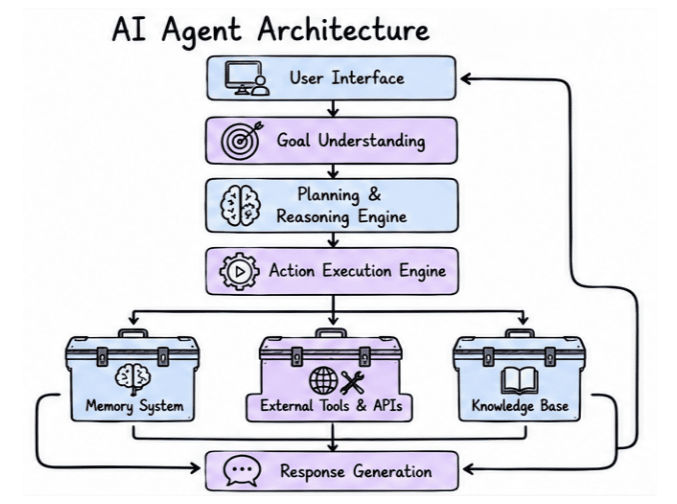
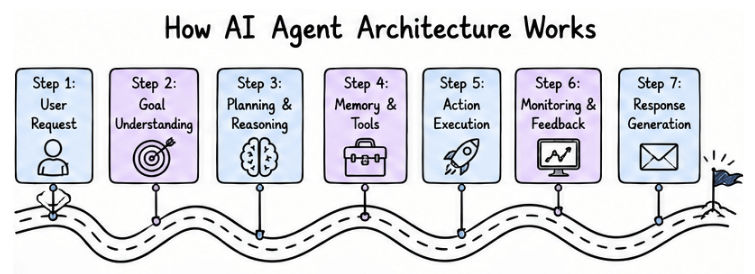
An AI agent follows a structured workflow to understand the user's request, make decisions, use the required tools, and generate the final response.
The workflow typically follows these steps:
User Request – The user provides a goal or task.
Goal Understanding – The agent understands what the user wants.
Planning & Reasoning – It creates a plan and decides the best approach.
Memory & Tools – The agent retrieves relevant information from memory and uses external tools or APIs when needed.
Action Execution – The planned actions are performed.
Monitoring & Feedback – The agent checks the results and makes improvements if required.
Response Generation – Finally, the agent prepares and returns the response to the user.
While AI Agent Architecture defines how an AI agent is designed, the AI Agent Lifecycle describes the step-by-step process the agent follows to complete a task.
After receiving a user's request, the agent moves through different stages to understand the goal, create a plan, perform the required actions, and generate the final response.
A typical AI Agent Lifecycle includes:
Goal Initialization
Context Acquisition
Task Planning
Action Execution
Monitoring
Evaluation
Replanning (if required)
Task Completion
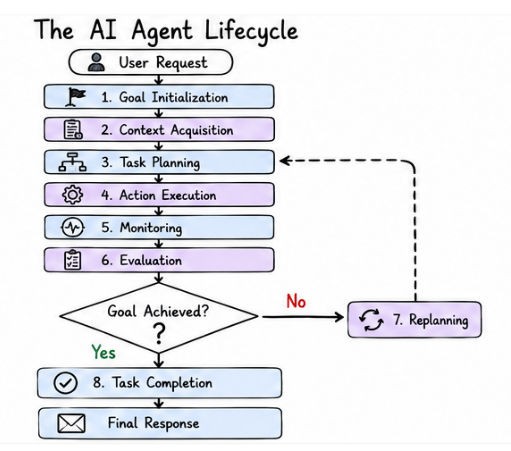
Each stage helps the agent move one step closer to achieving the user's objective.
The AI Agent Lifecycle begins when the user provides a goal or task. Before taking any action, the agent identifies what needs to be accomplished.
At this stage, the AI agent:
Receives the user's request
Identifies the main objective
Defines the expected outcome
Example:
"Find the best laptop under ₹80,000."
The agent identifies the goal and prepares to search, compare, and recommend the best options within the given budget.
After identifying the goal, the AI agent collects the information required to complete the task. This helps the agent understand the context before creating a plan.
Depending on the task, the agent may:
Retrieve previous conversation history
Access memory or a knowledge base
Search documents or databases
Use APIs to collect real-time information
Gather relevant data from external sources
Example:
"Continue the travel plan we created yesterday."
The agent retrieves the previous travel plan from memory before continuing with the task.
After collecting the required information, the AI agent creates a step-by-step plan to achieve the goal. It breaks the task into smaller actions and decides the best order to complete them.
Example: For a business meeting, the agent may:
Check everyone's availability
Find a suitable meeting time
Schedule the meeting
Send invitations
Notify participants
A clear plan helps the agent complete the task more efficiently.
Once the plan is ready, the AI agent starts performing each step. During execution, it can use external tools, APIs, databases, search engines, or other services to complete the task.
Some common actions include:
Searching the web
Reading documents
Calling APIs
Querying databases
Sending emails
Performing calculations
This is the stage where the AI agent carries out the planned actions and works toward completing the user's request.
While executing the task, the AI agent continuously monitors its progress. It checks whether each step is working correctly and identifies any errors or unexpected issues.
Monitoring helps the agent:
Track task progress
Detect errors
Identify missing information
Handle unexpected changes
Example: If an API request fails or a website is unavailable, the agent detects the issue and takes appropriate action instead of using incorrect information.
After completing the planned actions, the AI agent evaluates the results to ensure the task has been completed successfully.
During evaluation, the agent checks:
Was the user's request completed?
Is the information accurate?
Are all required steps finished?
Does the result match the expected outcome?
If the result meets the goal, the agent proceeds to the final stage.
If the original plan doesn't produce the expected result, the AI agent creates a new plan and continues working toward the goal.
The agent may:
Modify the existing strategy
Retry failed actions
Use a different tool
Search for alternative information
Example: If one travel website is unavailable, the agent automatically searches another website to complete the task.
After completing the task, the AI agent prepares the final response and presents the results in a clear and organized format.
If required, the agent also updates its memory with useful information for future interactions.
The completed result is then returned to the user, marking the end of the AI Agent Lifecycle.
             User Request
                   │
                   ▼
         Goal Initialization
                   │
                   ▼
         Context Acquisition
                   │
                   ▼
           Task Planning
                   │
                   ▼
          Action Execution
                   │
                   ▼
             Monitoring
                   │
                   ▼
             Evaluation
                   │
                   ▼
          Goal Achieved?
          ┌────────┴────────┐
         Yes               No
          │                 │
          ▼                 ▼
  Task Completion      Replanning
          ▲                 │
          └─────────────────┘
                   │
                   ▼
Final ResponseLet's understand the AI Agent Lifecycle with a simple example.
Suppose the user asks:
"Find the best smartphone under ₹30,000 and email me the comparison."
The AI agent completes the task in these stages:
Goal Initialization: Identifies the goal to compare smartphones and send the results by email.
Context Acquisition: Collects product details, prices, ratings, and user preferences.
Task Planning: Creates a step-by-step plan to search, compare, prepare the comparison, and send the email.
Action Execution: Searches online stores, compares smartphones, generates the comparison, and sends the email.
Monitoring: Tracks each step and detects any errors during execution.
Evaluation: Checks whether the comparison is accurate and the email was sent successfully.
Replanning (if needed): If a shopping website is unavailable, the agent uses another source and continues the task.
Task Completion: Returns the final result and confirms that the task has been completed.
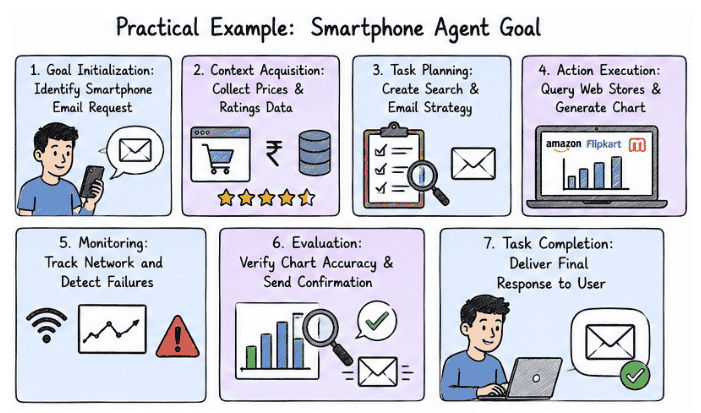
This example shows how an AI agent follows a structured lifecycle to complete a task efficiently instead of responding in a single step.
In this chapter, you learned what AI Agent Architecture is and how it connects different components such as planning, memory, reasoning, tool usage, and execution to help an AI agent complete tasks efficiently.
You also learned how the AI Agent Lifecycle works, from receiving a user's request to planning, executing, evaluating, and delivering the final response.
Understanding AI Agent Architecture and the AI Agent Lifecycle is essential for building intelligent, reliable, and scalable Agentic AI applications.
This knowledge provides a strong foundation for learning advanced topics such as AI agent frameworks, multi-agent systems, and autonomous AI applications.
