
Durgesh Tiwari
Author
Large Language Models (LLMs) are the technology behind modern AI tools such as ChatGPT, Google Gemini, Claude, and many AI assistants. These models can understand human language, answer questions, generate content, write code, summarize information, and perform many other language-based tasks.
A Large Language Model (LLM) is an AI model trained on massive amounts of text data to understand, process, and generate human language.
During training, LLMs learn language patterns, grammar, facts, context, and relationships from books, articles, websites, research papers, and other text sources.
Today, LLMs are used for:
Answering questions
Writing content and emails
Generating code
Summarizing documents
Translating languages
Research assistance
Building AI chatbots
ChatGPT
Google Gemini
Claude
Llama
Mistral
DeepSeek
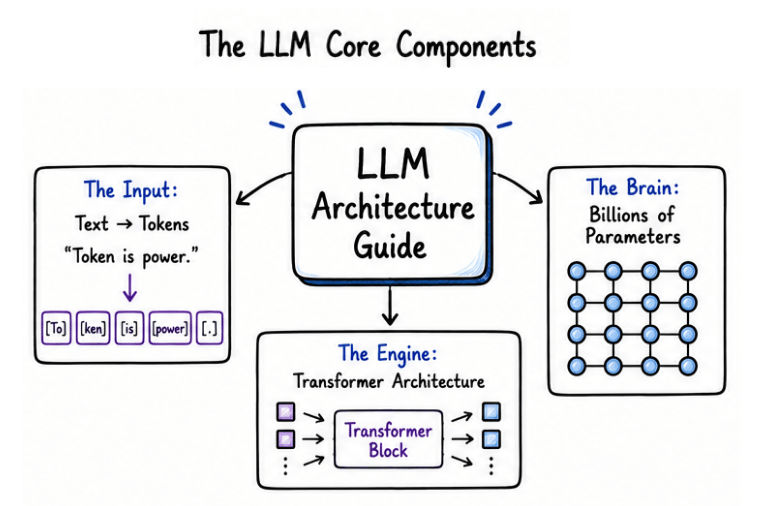
Language models have evolved from simple rule-based systems to powerful AI models capable of understanding and generating natural language.
Early language systems relied on predefined rules created by developers. They worked for simple tasks but could not learn from data.
These models predicted words using probability-based methods and improved language processing, but struggled with long-term context.
Neural networks enabled models to learn patterns directly from large datasets, improving language understanding and generation.
The introduction of the Transformer architecture in 2017 was a major breakthrough. Transformers improved efficiency, context understanding, and scalability.
Today's LLMs are trained on massive datasets and can perform a wide range of language tasks with impressive accuracy, powering many Generative AI applications.
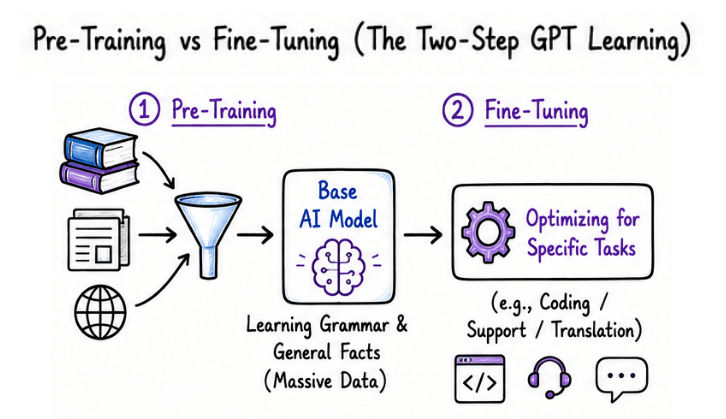
GPT stands for Generative Pre-trained Transformer. It is one of the most popular LLM architectures used in modern AI systems.
The model learns language patterns, grammar, context, and knowledge from large datasets.
The model can be further optimized for specific tasks such as:
Content creation
Customer support
Coding assistance
Research and productivity tools
GPT-1 – Introduced the GPT architecture.
GPT-2 – Improved text generation quality.
GPT-3 – Significantly expanded model capabilities.
GPT-4 and Beyond – Better reasoning, accuracy, and context handling for advanced AI applications.
Many organizations provide open-source or openly available language models that developers can customize and deploy.
Llama – Developed by Meta and widely used for AI applications.
Mistral – Known for strong performance and efficiency.
DeepSeek – Popular for language and coding tasks.
Falcon – Widely used for research and development.
Greater transparency
More customization options
Local deployment capability
Lower operational costs
Faster innovation and experimentation
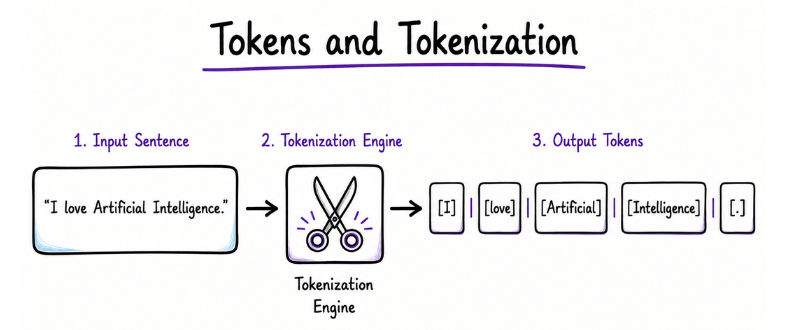
Before processing text, LLMs break it into smaller units called tokens. This process is known as tokenization.
A token can be:
A word
Part of a word
A character
A punctuation mark
Sentence:
I love Artificial Intelligence.
Possible tokens:
I
love
Artificial
Intelligence
.
Tokenization helps LLMs:
Process text efficiently
Understand language structure
Handle large datasets
Generate accurate responses
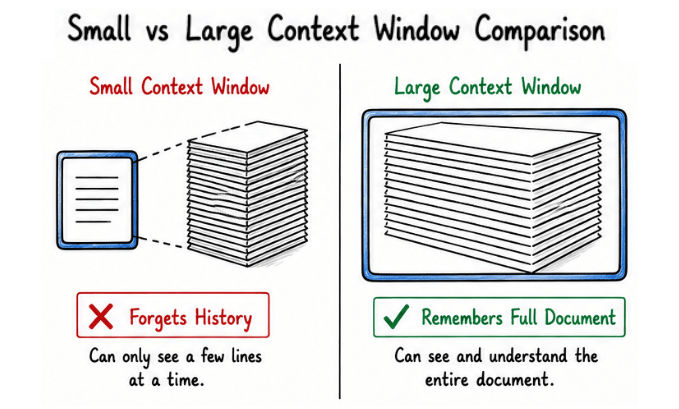
A context window is the amount of information an LLM can consider at one time while generating a response.
A larger context window helps the model:
Remember more conversation history
Analyze longer documents
Follow complex instructions
Generate more consistent responses
Context windows are important for:
Long conversations
Document analysis
Code generation
Research tasks
Multi-step reasoning
Model parameters are the internal values learned during training. They store the patterns and knowledge the model gains from data.
In simple terms, parameters represent the model's learned experience.
Parameters influence:
Language understanding
Response quality
Reasoning ability
Knowledge representation
Overall model performance
Modern LLMs are typically trained using billions of parameters, allowing them to handle complex language tasks more effectively.
Large Language Models (LLMs) are advanced AI systems trained on massive amounts of text data to understand and generate human language. They power modern AI applications such as chatbots, coding assistants, content generation tools, and virtual assistants.
Understanding concepts like GPT models, open-source LLMs, tokenization, context windows, and model parameters provides a strong foundation for learning advanced topics such as Prompt Engineering, RAG, AI Agents, and modern Generative AI development.
