
Durgesh Tiwari
Author
Not all AI systems work in the same way. Some AI tools are designed for specific tasks, while future AI systems may be able to learn and think more like humans. Based on their capabilities, Artificial Intelligence is commonly divided into three types:
Narrow AI
General AI
Super AI

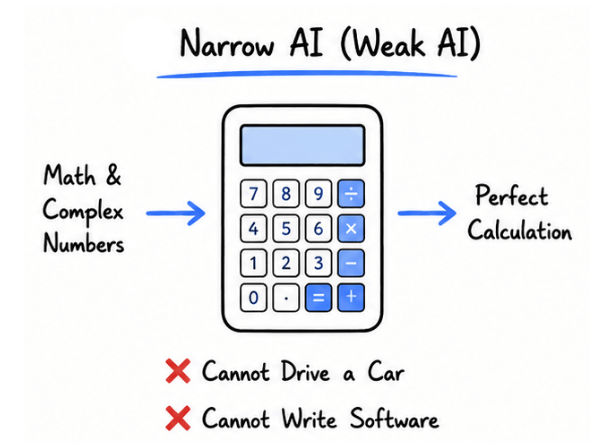
Narrow AI, also known as Weak AI, is the most common type of Artificial Intelligence used today. It is designed to perform a specific task and works only within the area it has been trained for.
For example, a voice assistant can answer questions and set reminders, but it cannot perform unrelated tasks such as driving a car or developing software.
A simple way to understand Narrow AI is to think of a calculator. It performs mathematical calculations very well but cannot do tasks outside its purpose.
Google Search
YouTube recommendations
Siri, Alexa, and Google Assistant
Face unlock in smartphones
Website chatbots
Netflix and Amazon recommendations
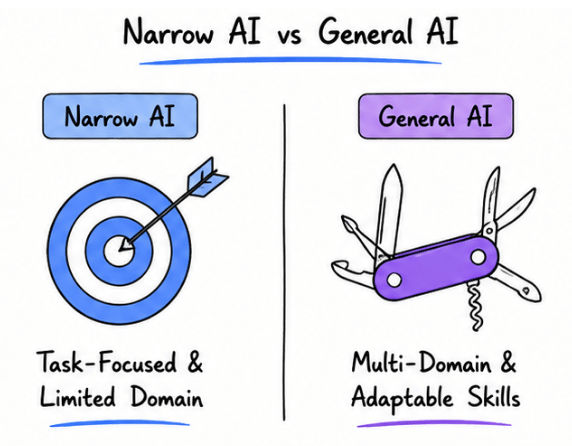
General AI refers to a theoretical form of Artificial Intelligence that can perform any intellectual task a human can perform.
Unlike Narrow AI, it would be able to learn new skills, adapt to different situations, and apply knowledge across multiple domains without being trained separately for each task.
For example, just as a person can learn cooking, driving, teaching, and music, a General AI system would be able to learn and perform all these activities.
Although General AI remains one of the biggest goals in AI research, no true General AI system exists today.
Super AI is a future concept in which machines could become more intelligent than humans in almost every area.
It is expected to outperform humans in problem-solving, creativity, decision-making, scientific research, and other complex tasks.
Unlike General AI, which aims to match human intelligence, Super AI is imagined as a level of intelligence that goes beyond human capabilities.
At present, Super AI exists only as a theoretical idea. Researchers and technology experts continue to discuss its potential benefits, challenges, and ethical concerns.
The following comparison makes it easier to understand the difference between Narrow AI and General AI.
Feature | Narrow AI | General AI |
|---|---|---|
Purpose | Designed for specific tasks | Designed for any intellectual task |
Learning | Limited to a particular area | Can learn across different areas |
Adaptability | Low | High |
Intelligence Level | Task-focused | Human-like intelligence |
Current Status | Widely used today | Not available yet |
Examples | Search engines, chatbots, recommendation systems | No real-world examples |
Narrow AI powers most of the applications we use today, while General AI remains a future goal of Artificial Intelligence research.
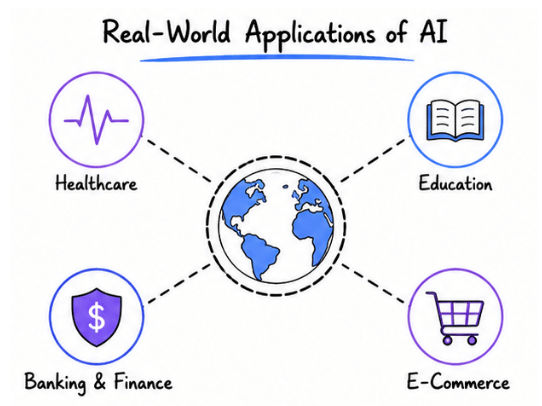
Artificial Intelligence is already transforming many industries by improving efficiency, reducing manual work, and helping people make better decisions.
AI helps healthcare professionals:
Detect diseases early
Analyze medical images and reports
Support diagnosis
Predict health risks
Example: AI-powered systems can identify abnormalities in medical scans and assist doctors in making faster decisions.
AI is making learning more personalized and effective.
Personalized learning recommendations
AI tutors and learning assistants
Automated assessments
Smart study suggestions
Example: Online learning platforms recommend lessons based on a student's performance and progress.
Financial institutions use AI to improve security and customer services.
Fraud detection
Credit risk assessment
Financial analysis
Customer support automation
Example: Banks can identify suspicious transactions and prevent potential fraud.
Online businesses use AI to improve customer experience.
Product recommendations
Personalized shopping experiences
Customer behavior analysis
Inventory management
Example: Shopping platforms suggest products based on browsing history and previous purchases.
AI is helping create smarter transportation systems.
Traffic prediction
Route optimization
Navigation assistance
Self-driving vehicle research
Example: Navigation apps provide the fastest routes using real-time traffic information.
AI helps platforms deliver content that matches user interests.
Movie recommendations
Music suggestions
Video recommendations
Personalized content feeds
Example: Streaming services recommend content based on viewing history and preferences.
AI plays an important role in protecting digital systems.
Threat detection
Security monitoring
Cyber attack prevention
Risk analysis
Example: Security systems can detect unusual login attempts and identify potential threats.
Artificial Intelligence can be classified into Narrow AI, General AI, and Super AI based on its capabilities. Most AI systems used today are examples of Narrow AI, while General AI and Super AI remain future concepts.
From healthcare and education to banking, e-commerce, transportation, and cybersecurity, AI is transforming industries and becoming an important part of everyday life.
