

How AI Is Changing Software Jobs in 2026: What Developers Must Know
Artificial Intelligence (AI) is no longer something for the future. In 2026, AI is already a big part of the software industry. It is changing how code is written, how teams work, and how developers are hired.
If you are a software developer, engineering student, or IT professional, AI directly affects your career. To stay relevant and grow in this field, it is important to understand how AI is changing software jobs.
In this blog, we will explain what is changing, which jobs are evolving, what skills are important, and how you can prepare for 2026.
Why AI Is Changing Software Jobs So Fast
In 2026, AI is used in almost every stage of software development. Companies use AI to:
- Write and review code faster
- Find and fix bugs automatically
- Improve application performance
- Manage deployment and DevOps tasks
- Save time and reduce costs
AI is not replacing developers, but it is changing what companies expect from them.
Today, developers are valued for:
- Solving problems
- Thinking at a system level
- Making good technical decisions
- Using AI tools correctly
How AI Is Changing the Role of Software Developers
1. Coding Is No Longer the Most Important Skill
AI tools like ChatGPT, GitHub Copilot, Cursor, and Codeium can now:
- Write basic code
- Suggest full functions
- Fix common errors
- Improve existing code
Because of this, writing code line by line is less important.
In 2026, good developers are those who:
- Know what to build
- Understand why it is needed
- Can clearly guide AI tools to get correct results
2. Junior Software Jobs Are Changing
Earlier, junior developers mainly worked on:
- Writing simple code
- Fixing small bugs
- Following instructions
Now, AI can do many of these tasks.
So, junior developers must offer more value, such as:
- Strong basics (DSA, OOP, databases)
- Good logical thinking
- Ability to use AI tools
- Real project experience
Developers who depend only on tutorials and copying code find it hard to grow in 2026.
3. Senior Developers Are More Important Than Ever
AI has increased the demand for experienced developers.
Senior developers now focus on:
- Designing scalable systems
- Making architecture decisions
- Reviewing AI-generated code
- Handling security and performance
- Guiding junior developers
AI helps senior developers, but it cannot replace their experience.
Software Jobs That Are Changing (Not Ending)

Backend Developers
AI can create basic APIs, but backend developers are still needed for:
- System design
- Database structure
- Security and authentication
- Performance improvements
Frontend Developers
AI helps with UI code, but humans handle:
- User experience (UX)
- Accessibility
- Design decisions
- Speed and performance
QA and Testing Engineers
Manual testing is reducing, but AI testing is growing:
- Automated test cases
- Smart bug detection
- Continuous testing
DevOps Engineers
AI helps in:
- CI/CD pipelines
- System monitoring
- Infrastructure optimization
DevOps jobs are becoming smarter, not fewer.
New Software Jobs Created by AI in 2026
AI is also creating new career roles, such as:
- AI-Assisted Software Engineer
- Prompt Engineer
- AI Workflow Architect
- Machine Learning Platform Engineer
- AI Security Engineer
- Data and AI Integration Engineer
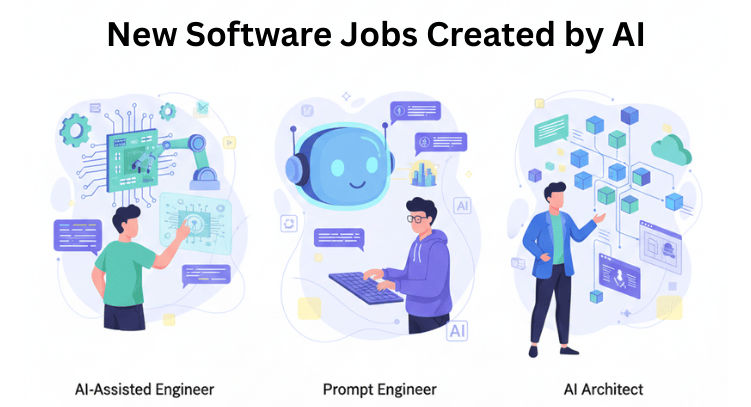
These roles mix software development skills with AI knowledge.
Skills That Matter Most in 2026
Technical Skills
- Problem solving
- System design
- API development
- Cloud basics
- DevOps fundamentals
- Using AI tools properly
Non-Technical Skills
- Clear thinking
- Communication
- Adaptability
- Continuous learning

In 2026, companies prefer developers who can think clearly, not just write code.
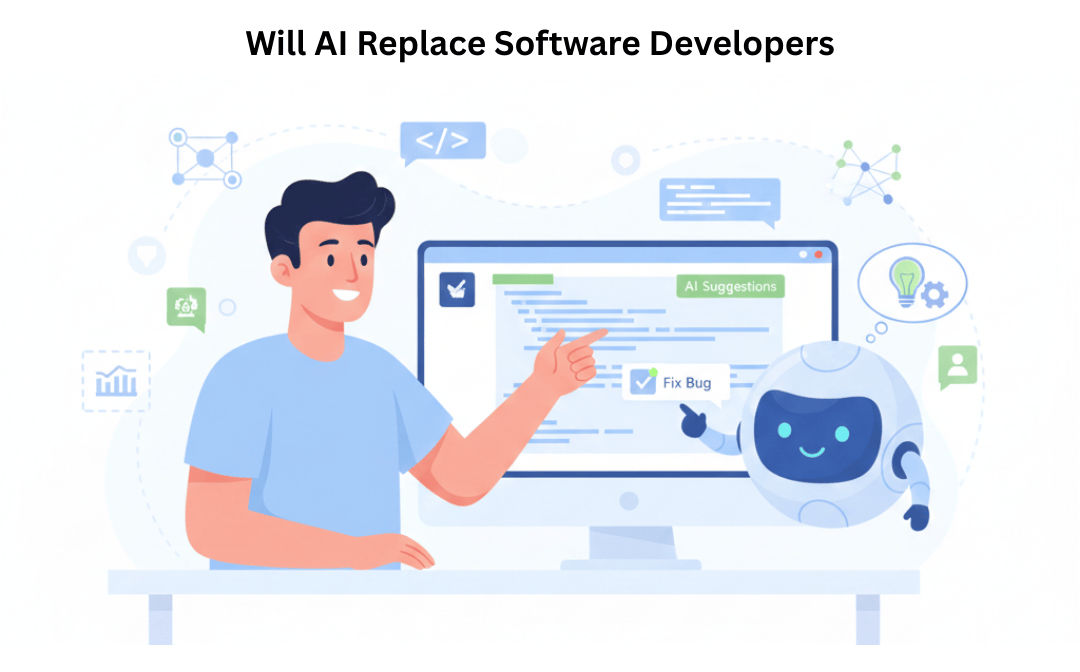
Will AI Replace Software Developers?
This is one of the most common questions online.
The simple answer is:
AI will not replace software developers.
But it will replace developers who do not learn new skills.
AI cannot:
- Fully understand business needs
- Take responsibility for decisions
- Communicate with clients and teams
- Design complex systems alone
Developers who learn to work with AI will always have opportunities.
How to Stay Relevant as a Software Developer in 2026
- Use AI as a helper, not a shortcut
- Improve your fundamentals (DSA, OS, DBMS, Networking)
- Build real projects using AI tools
- Learn system design
- Keep learning new technologies
Final Thoughts: The Future of Software Jobs
AI is changing software jobs, but this change is positive.
In 2026:
- Smart developers use AI
- Average developers struggle
- Growth belongs to those who adapt
Instead of asking:
“Will AI take my job?”
Ask:
“How can AI help me become a better developer?”
FAQs: How AI Is Changing Software Jobs in 2026
Ques 1: Will AI replace software developers?
Ans: No. AI automates repetitive tasks, but developers who use AI effectively and focus on problem-solving and system design remain in demand.
Ques 2: What new software jobs does AI create?
Ans: Roles like AI-Assisted Software Engineer, Prompt Engineer, AI Workflow Architect, ML Platform Engineer, and AI Security Engineer.
Ques 3: How is AI affecting junior developers?
Ans: AI handles basic coding and bug fixes, so juniors must focus on fundamentals, logic, and working with AI tools.
Ques 4: Which skills matter most in 2026?
Ans: Problem-solving, system design, cloud & API development, AI tool usage, adaptability, and continuous learning.
Ques 5: How is AI transforming software roles?
Ans:
- Backend: Architecture, security, optimization remain human-led.
- Frontend: UX, accessibility, performance still need humans.
- QA: AI automates testing.
- DevOps: AI improves CI/CD and monitoring.
Ques 6: What AI tools do developers use?
Ans: GitHub Copilot, ChatGPT, Codeium, Cursor, and AI testing frameworks.
Ques 7: How can developers stay relevant?
Ans: Treat AI as a partner, strengthen fundamentals, build real projects, learn system design, and keep updating skills.
Ques 8: Is AI more helpful for seniors or juniors?
Ans: Both. Juniors get faster learning and automation; seniors get support in code review, architecture, and optimization.