

Building Scalable Java Microservices with Spring Boot: Production Best Practices for 2025
Microservices architecture has become the backbone of modern enterprise applications. In 2025, organizations demand systems that are scalable, resilient, cloud-native, and secure, and Java with Spring Boot continues to be one of the most trusted stacks for building such solutions.
This guide explains real-world Spring Boot microservices best practices, along with practical examples, to help you design, develop, and deploy production-ready Java microservices with confidence.
Whether you are a beginner or an experienced backend developer, this article will help you align your microservices architecture with modern industry standards.
What Is Java Microservices Architecture?
Java microservices architecture is an approach where a large application is broken into small, independent services, each responsible for a specific business capability.
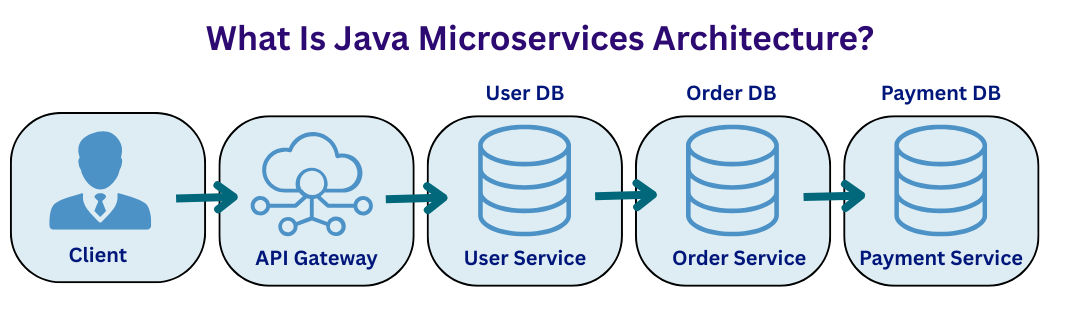
Each microservice:
- Is independently deployable
- Owns its own database
- Communicates via REST APIs or messaging
- Can scale independently
Spring Boot simplifies this architecture by providing:
- Embedded servers (Tomcat, Netty)
- Auto-configuration
- Production-ready features via Actuator
Why Spring Boot for Microservices in 2025?
Spring Boot remains the top choice because it offers:
✅ Rapid development with minimal configuration
✅ Cloud-native compatibility
✅ Strong Spring ecosystem (Spring Data, Spring Security, Spring Cloud)
✅ Excellent community and enterprise support
✅ Seamless integration with Docker & Kubernetes
With Spring Boot 3+ and Spring Cloud, developers can build enterprise-grade microservices faster and more reliably than ever.
Core Spring Boot Microservices Best Practices (Production Ready)
1. Design Microservices Around Business Domains

Avoid creating microservices based on technical layers like controller or repository services.
Best approach: Domain-Driven Design (DDD)
Example (E-commerce System)
- User Service → user registration, login, profiles
- Order Service → order creation, order tracking
- Payment Service → payment processing
- Notification Service → email & SMS notifications
Each service should:
- Have a single responsibility
- Own its data
- Evolve and deploy independently
2. Use Independent Databases Per Microservice
Sharing databases between microservices is a strict anti-pattern.
- Each service must have its own database
- Enables independent scaling and deployment
- Prevents tight coupling

Example
User Service → user_db
Order Service → order_db
Payment Service → payment_db
For data consistency across services, use:
- Event-driven architecture
- Saga pattern
3. Externalize Configuration Using Spring Profiles
Never hardcode environment-specific values.
Use different configuration files:
application-dev.ymlapplication-test.ymlapplication-prod.yml
Example
# application-prod.yml
server:
  port: 8081

spring:
  datasource:
    url: jdbc:mysql://prod-db:3306/orderdb
Activate profile using:
-Dspring.profiles.active=prod
Benefits:
- Clean configuration management
- Easy environment switching
- Secure handling of secrets
4. Centralized Configuration Management
For large-scale systems, manage configuration centrally using:
- Spring Cloud Config Server
- Kubernetes ConfigMaps & Secrets
Advantages:
- Dynamic configuration updates
- Centralized control
- Reduced redeployment
5. Service-to-Service Communication
Use lightweight and reliable communication mechanisms:
- REST APIs (OpenAPI / Swagger)
- Messaging (Kafka / RabbitMQ)
Avoid long synchronous chains that increase latency.

Practical Example: Feign Client
@FeignClient(name = "payment-service")
public interface PaymentClient {

    @PostMapping("/payments")
    PaymentResponse makePayment(@RequestBody PaymentRequest request);
}
Order Service can call Payment Service without writing boilerplate REST code.
6. Implement Resilience & Fault Tolerance
In distributed systems, failures are inevitable.
Use:
- Circuit breakers
- Timeouts
- Retries
- Bulkheads
Tools:
- Resilience4j
- Spring Cloud Circuit Breaker
Example
@CircuitBreaker(name = "paymentService", fallbackMethod = "fallbackPayment")
public PaymentResponse pay() {
    return paymentClient.makePayment();
}
If Payment Service fails, fallback logic prevents system crash.
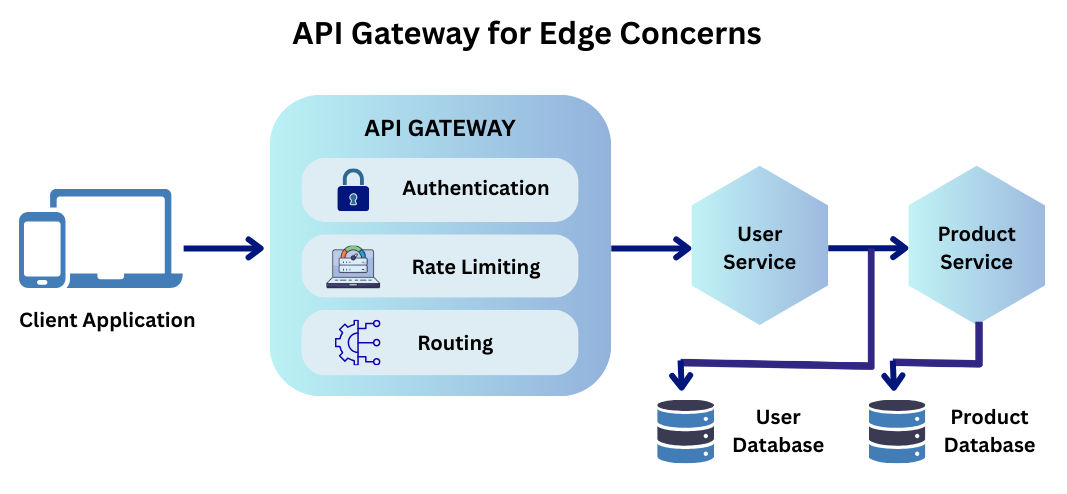
7. Use an API Gateway
Never expose internal microservices directly to clients.
API Gateway handles:
- Authentication & Authorization
- Rate limiting
- Request routing
- API versioning
Popular choices:
- Spring Cloud Gateway
- Kong
- Istio Gateway
8. Secure Your Microservices
Security is critical in production environments.
Best practices:
- OAuth 2.0 / OpenID Connect
- JWT-based authentication
- HTTPS everywhere
- Role-based access control
Spring Security integrates seamlessly with Spring Boot for secure microservices.
9. Observability: Logging, Monitoring & Tracing
You cannot fix what you cannot see.
Implement:
- Centralized logging (ELK stack)
- Metrics (Micrometer + Prometheus)
- Distributed tracing (Zipkin / OpenTelemetry)
Monitor key metrics:
- Response time
- Error rate
- Throughput
- CPU & memory usage
10. Containerization & Cloud Deployment
In 2025, container-first deployment is the industry standard.
Docker Example
FROM openjdk:17-jdk-slim
COPY target/app.jar app.jar
ENTRYPOINT ["java","-jar","app.jar"]
Deploy using:
- Docker
- Kubernetes
Use Spring Boot Actuator:
/actuator/health
for health checks and auto-scaling.
11. Version Your APIs Properly
Never break existing clients unintentionally.
API versioning strategies:
- URL versioning (
/api/v1/orders) - Header-based versioning
Maintain backward compatibility whenever possible.
12. CI/CD for Microservices
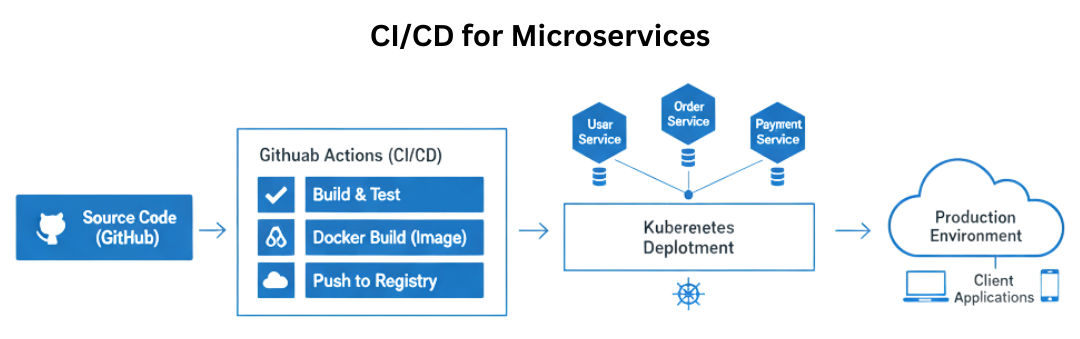
Automate everything using CI/CD pipelines.
Pipeline should include:
- Code quality checks
- Automated tests
- Docker image build
- Deployment to Kubernetes
Popular tools:
- GitHub Actions
- Jenkins
- GitLab CI/CD
Common Mistakes to Avoid
- Overusing microservices
- Sharing databases
- Ignoring monitoring & logging
- Tight coupling between services
- Poor API design
Microservices bring complexity—use them only when justified.
Frequently Asked Questions (FAQs)
1. What are Java microservices?
Java microservices are small, independent services built using Java that handle specific business functions. Each service runs separately, owns its data, and communicates with other services using APIs or messaging.
2. Why should I use Spring Boot for microservices?
Spring Boot simplifies microservices development by providing auto-configuration, embedded servers, and production-ready features. It also integrates easily with Docker, Kubernetes, and cloud platforms.
3. Is Spring Boot suitable for production microservices?
Yes, Spring Boot is widely used in production systems. With Spring Security, Spring Boot Actuator, Spring Cloud, and Resilience4j, it supports scalability, security, monitoring, and fault tolerance.
4. Should each microservice have its own database?
Yes, each microservice should have its own database. This ensures loose coupling, independent scaling, and easier maintenance in a microservices architecture.
5. How do microservices communicate with each other?
Microservices communicate using REST APIs for synchronous calls and messaging systems like Kafka or RabbitMQ for asynchronous, event-driven communication.
Conclusion
Spring Boot microservices remain a powerful and future-proof solution for building scalable Java applications in 2025.
By following these production best practices with practical examples, you can:
- Reduce system failures
- Improve scalability
- Increase deployment speed
- Build maintainable systems
Microservices are not about breaking code into pieces — they are about building systems that scale with your business.