

Learn AI Without Heavy Math - A Practical Path for Students & Developers (2026)
For many students and developers, Artificial Intelligence (AI) sounds exciting — until math shows up.
Words like linear algebra, probability, and calculus scare beginners away before they even start. As a result, many people assume AI is only for mathematicians or PhD researchers.
But here’s the truth most people don’t tell you:
? You can learn and use AI without mastering heavy mathematics.
This guide is designed for students, developers, and beginners who want practical AI skills without academic complexity.
In 2026, AI is no longer a research-only subject. It’s a practical skill, just like web development, cloud computing, or DevOps. This guide will show you how to learn AI step by step, without getting stuck in complex formulas — and still build real projects and career-ready skills.
Do You Really Need Heavy Math to Learn AI?
Short answer: No — not in the beginning.
The confusion happens because people mix up using AI with researching AI.
Here’s the reality:
- AI researchers need deep math
- AI engineers need basic concepts
- AI users and developers mostly need tools, logic, and problem-solving
If your goal is to:
- Use AI tools
- Build AI-powered applications
- Automate tasks
- Improve productivity
- Get an AI-related job
? Heavy math is not mandatory.
How Much Math Is Actually Required?
Let’s simplify this clearly.
Level 1: AI User (No Math Needed)
- Using ChatGPT and AI tools
- Prompt writing
- Automation
- Content, coding, and productivity
Level 2: AI Developer (Basic Conceptual Math)
- Simple logic
- Understanding probability in plain language
- No formulas or derivations
Level 3: AI Researcher (Heavy Math)
- Linear algebra
- Calculus
- Statistics
- Model optimization
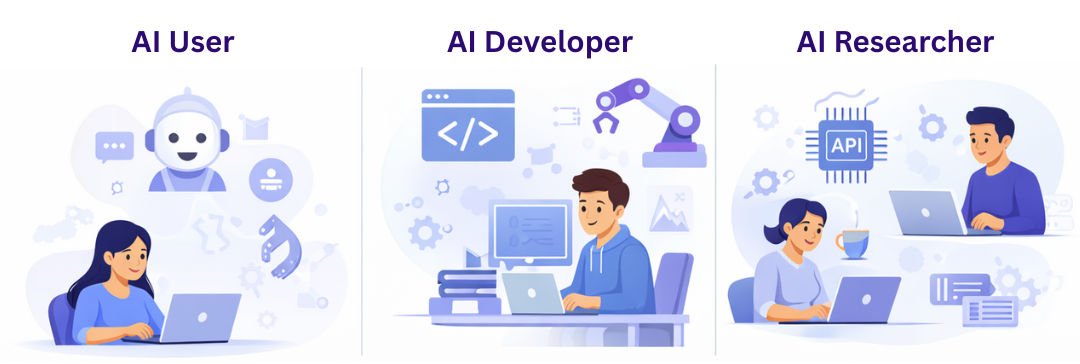
✅ Most students and developers should start at Level 1 and Level 2.
Types of AI You Can Learn Without Heavy Math
Not all AI fields are math-heavy. In fact, many popular and high-demand AI areas are practical and tool-based.
1. Generative AI
- Text generation
- Image creation
- Code generation
- Chatbots
2. Applied AI
- Resume screening tools
- Recommendation systems
- AI-powered dashboards
3. AI for Developers
- AI APIs
- AI-powered web and mobile apps
- Workflow automation
4. AI Agents & Automation
- Task-based AI agents
- Business automation
- Productivity tools
? These areas focus more on implementation, not equations.
The Tools-First Approach to Learning AI (2026 Method)
The smartest way to learn AI in 2026 is tools first, theory later.
Popular AI Tools You Can Start With
- ChatGPT and Gemini for learning and automation
- GitHub Copilot and Cursor for AI-assisted coding
- AutoML tools to train models without math
- No-code and low-code AI platforms
- AI agent builders for task automation
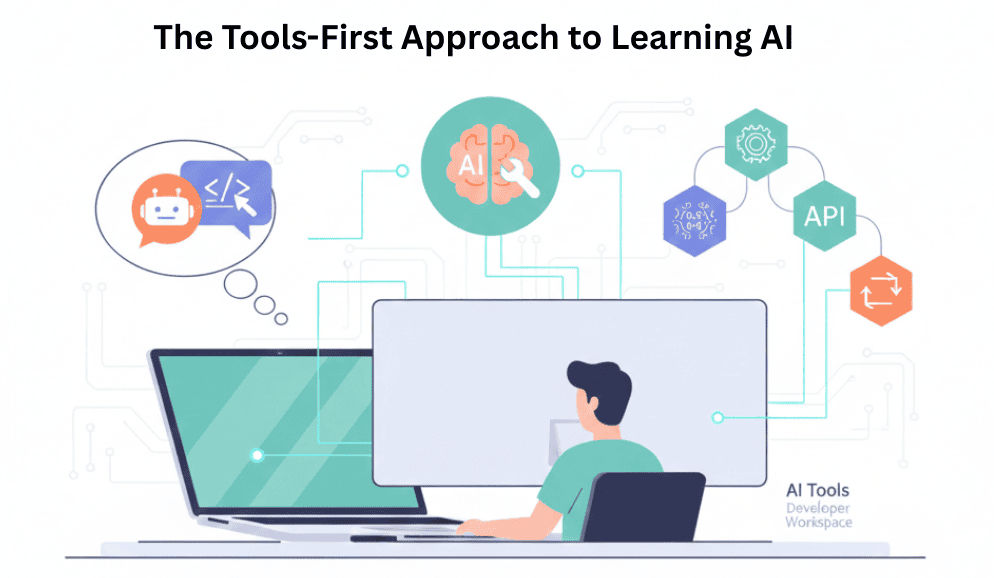
These tools hide the math and let you focus on:
- Inputs
- Outputs
- Logic
- Real-world use cases
A Practical AI Learning Roadmap
Step 1: Become an AI User
Start using AI daily:
- Ask questions
- Write prompts
- Solve problems
- Learn faster with AI
? This builds confidence and removes fear.
Step 2: Become an AI Integrator
Learn how to:
- Use AI APIs
- Connect AI with websites or apps
- Automate simple workflows
You’ll start seeing AI as a tool, not a mystery.
Step 3: Build Simple AI Projects
No math-heavy projects required.
Beginner project ideas:
- AI chatbot for a website
- Resume shortlisting tool
- AI study assistant
- Blog or content generator
- Code review assistant
In 2026, projects matter more than theory.
Minimum Math You Should Know (Keep It Simple)
You don’t need formulas. Just basic understanding:
- Percentages
- Averages
- Basic logic
- Probability in simple language
That’s it.
No calculus. No proofs.
Best Free Resources to Learn AI Without Math
You don’t need expensive courses to start.
Useful learning sources:
- Official AI tool documentation
- Beginner-friendly YouTube channels
- AI communities and forums
- Free tutorials and blogs
- Practice-based learning platforms
Focus on learning by doing, not memorizing concepts.
AI Careers You Can Enter Without Heavy Math
Yes — real jobs exist.
AI roles with low math dependency:
- AI Prompt Engineer
- AI Tool Specialist
- AI Automation Expert
- AI-Powered Web Developer
- AI Content and SEO Specialist
- AI Product Analyst
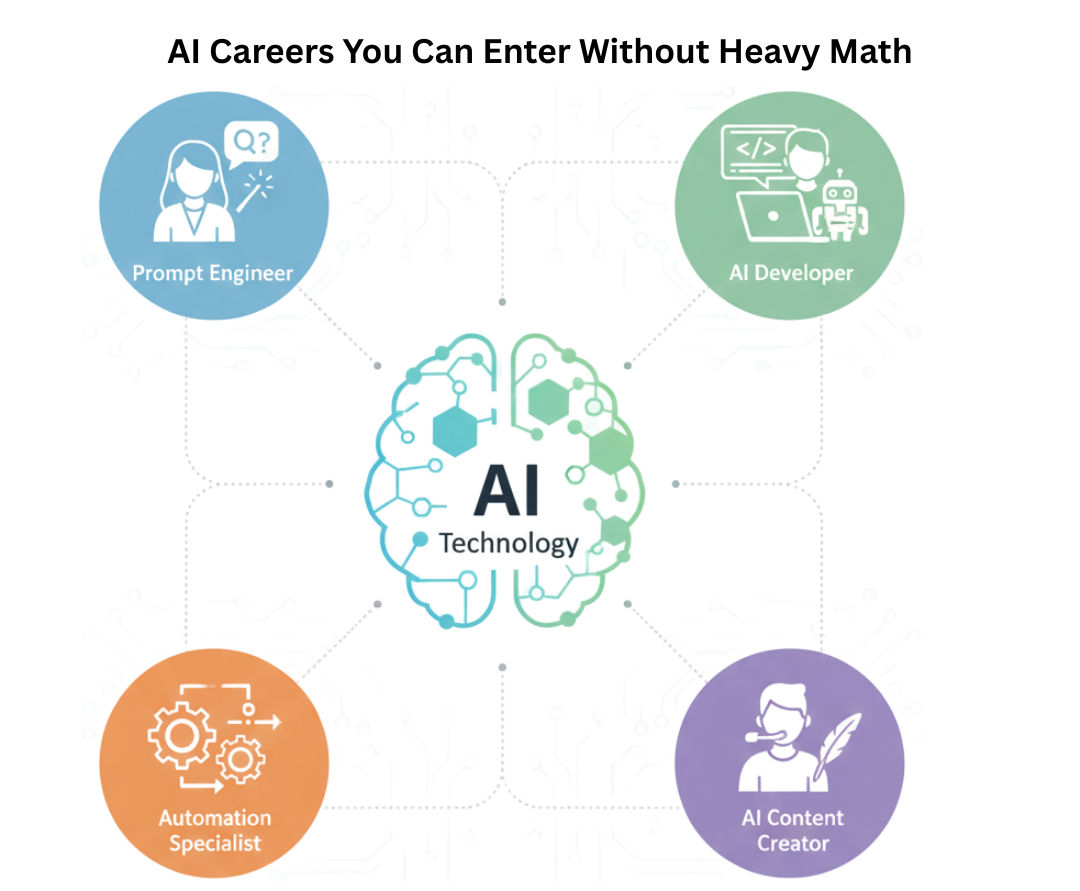
Companies care about skills and results, not math grades.
Common Mistakes Beginners Make
Avoid these:
- Starting with advanced math books
- Waiting to “learn everything first”
- Ignoring practical tools
- Being afraid AI will replace jobs
? AI replaces tasks, not skilled people.
Is Learning AI Without Math Future-Safe?
Yes — if done smartly.
Start practical, then:
- Add concepts gradually
- Learn math only when needed
- Go deeper based on interest
AI learning is a journey, not a one-time subject.
Conclusion
AI is no longer optional — but fear is.
You don’t need to be a math genius to:
- Learn AI
- Use AI
- Build with AI
- Earn with AI
Start small.
Use tools.
Build projects.
Upgrade skills gradually.
? AI is a skill — not a math exam.
FAQs – Learn AI Without Heavy Math
1. Can I really learn AI without being good at math?
Yes. You can learn and use AI without advanced math. Most modern AI tools and frameworks handle complex mathematics internally. Beginners only need to understand concepts, tools, and real-world use cases.
2. How much math do I actually need to start learning AI?
Only basic math is required, such as percentages, averages, and simple logical thinking. Advanced topics like calculus and linear algebra are not needed at the beginner level.
3. Can non-technical students learn AI?
Yes. Non-technical students can start with AI tools, prompt writing, automation, and no-code or low-code platforms. Programming skills can be learned gradually if required.
4. Do I need to learn Python to work with AI?
Python is helpful but not mandatory in the beginning. Many AI tools work without coding. Learning basic Python later can help you build more advanced AI applications.
5. Can I get a job in AI without heavy math knowledge?
Yes. Many AI roles focus on practical skills such as AI tool usage, automation, prompt engineering, and AI-powered app development rather than mathematical theory.
6. Which AI fields require the least amount of math?
Generative AI, AI automation, AI agents, applied AI, and AI-powered web or mobile development require minimal math and focus more on implementation and tools.
7. Is learning AI without math future-proof?
Yes. Starting with practical AI skills is future-safe. You can always learn more math later if your role or interest requires deeper technical knowledge.