

Monolith vs Microservices – Real-World Comparison
Introduction
When building modern software applications, one of the most important decisions is choosing the right architecture.
Two of the most widely used approaches are:
Both are used in real-world production systems, but they are completely different in structure, scalability, and deployment style.
In this blog, we will understand Monolith vs Microservices in simple English, along with real-world examples, coding examples, advantages, disadvantages, and FAQs.
What is Monolithic Architecture?
A Monolithic architecture means building an application as a single unified system.
In a monolith, all features are packed into one codebase and deployed as one application.
Example of Monolithic Application
Imagine an e-commerce system:
User Management (Login/Register)
Product Catalog
Shopping Cart
Order Management
Payment System
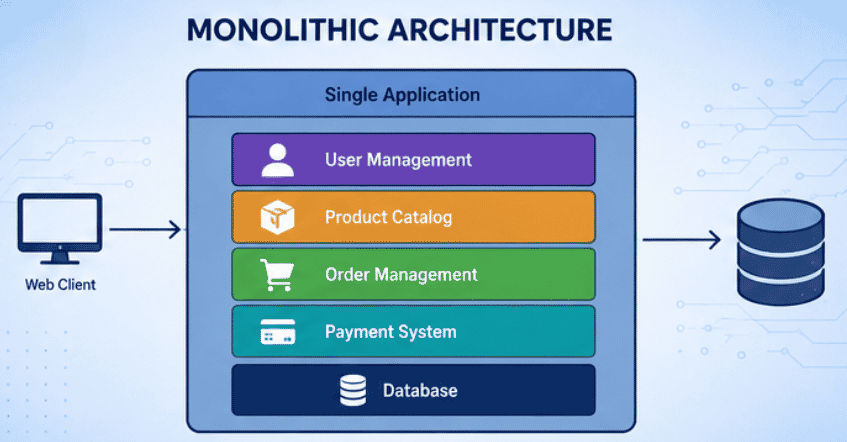
All these modules are inside one single application.
Simple Monolith Example (Spring Boot)
@RestController
@RequestMapping("/api")
public class ECommerceController {

    @GetMapping("/products")
    public List<String> getProducts() {
        return List.of("Laptop", "Mobile", "Tablet");
    }

    @PostMapping("/order")
    public String placeOrder() {
        return "Order placed successfully";
    }

    @PostMapping("/payment")
    public String makePayment() {
        return "Payment successful";
    }
}
👉 In this structure, everything runs inside a single application.
Key Features of Monolith Architecture
Single codebase for entire application
Single deployment unit
All modules tightly connected
Simple project structure
Easy to develop in early stages
Advantages of Monolith Architecture
Easy to Build: Monolith is simple and beginner-friendly. It is ideal for small applications.
Simple Deployment: Only one application needs to be deployed on the server.
Easy Testing: Since everything is in one place, testing is straightforward.
Faster Initial Development: No need to manage communication between services.
Disadvantages of Monolith Architecture
Hard to Scale: If one feature (like payments) gets high traffic, the entire application must be scaled.
Slow Updates: Even a small change requires redeploying the whole system.
Tight Coupling: All modules depend on each other, so changes can affect multiple parts.
Difficult for Large Teams: Many developers working on the same codebase can cause conflicts.
What is Microservices Architecture?
at is Microservices Architecture?
A Microservices architecture breaks an application into multiple small independent services.
Each service handles a specific business function and runs independently.
Example of Microservices System (E-commerce)
Product Service → handles products
Order Service → handles orders
Payment Service → handles payments
Inventory Service → handles stock
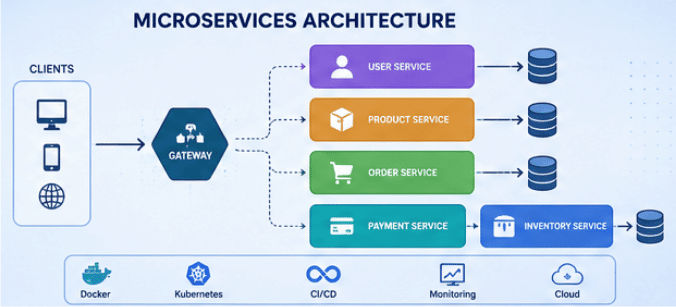
Each service is deployed separately.
Microservices Example (Spring Boot)
1. Product Service
@RestController
@RequestMapping("/products")
public class ProductController {

    @GetMapping
    public List<String> getProducts() {
        return List.of("Laptop", "Mobile", "Tablet");
    }
}
2. Order Service
@RestController
@RequestMapping("/orders")
public class OrderController {

    @PostMapping
    public String createOrder() {
        return "Order created successfully";
    }
}
3. Payment Service
@RestController
@RequestMapping("/payments")
public class PaymentController {

    @PostMapping
    public String processPayment() {
        return "Payment processed successfully";
    }
}
Communication Between Microservices
Microservices communicate with each other using REST APIs or messaging systems.
Example: Order Service calling Product Service
@RestController
@RequestMapping("/orders")
public class OrderController {

    @Autowired
    private RestTemplate restTemplate;

    @PostMapping
    public String createOrder() {

        String product = restTemplate.getForObject(
            "<http://PRODUCT-SERVICE/products>",
            String.class
        );

        return "Order placed for product: " + product;
    }
}
Key Features of Microservices Architecture
Multiple small services
Independent deployment
Each service can have its own database
Communication through APIs
Highly scalable architecture
Advantages of Microservices
Easy to Scale: Each service can be scaled independently based on demand.
Independent Deployment: One service can be updated without affecting others.
Better Fault Isolation: If one service fails, other services continue working.
Suitable for Large Systems: Used in large platforms like Amazon, Netflix, and Uber.
Disadvantages of Microservices
Complex Architecture: Harder to design, manage, and maintain.
Network Latency: Services communicate over the network, which adds delay.
Hard Debugging: Tracking issues across multiple services is difficult.
Requires DevOps Knowledge: Needs CI/CD, Docker, Kubernetes, monitoring tools, etc.
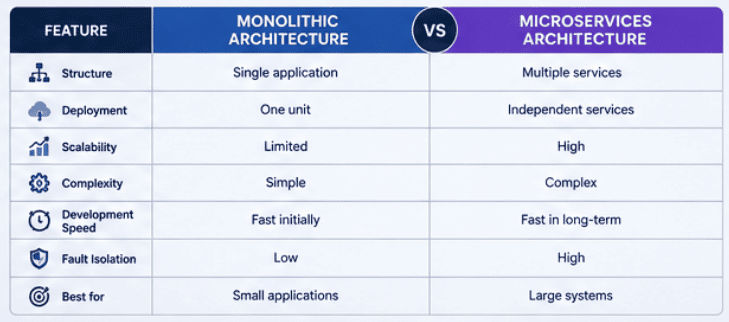
Monolith vs Microservices – Real-World Comparison Table
Feature | Monolith | Microservices |
|---|---|---|
Structure | Single unified application | Multiple independent services |
Deployment | Entire application deployed as one unit | Each service deployed independently |
Scalability | Scales as a whole application (limited flexibility) | Each service scales independently |
Complexity | Simple to develop and manage initially | Complex due to distributed system |
Development Speed | Faster in early stages | Faster in long-term for large systems |
Fault Isolation | Low (one failure can affect whole app) | High (failure isolated to one service) |
Codebase | Single large codebase | Multiple smaller codebases |
Technology Stack | Usually single technology | Can use multiple technologies |
Communication | Internal function calls | Network-based communication (REST, Messaging) |
Best For | Small apps, startups, MVPs | Large-scale systems, enterprise apps |
Real-World Examples
Monolith Example
A startup builds a food delivery application.
One Spring Boot application handles everything
Easy to build and deploy
Works well for small user base
👉 Best for early-stage startups
Microservices Example
Large platforms like Amazon or Flipkart:
Millions of users
High traffic
Multiple teams working simultaneously
Services like:
Product Service
Payment Service
Order Service
Delivery Service
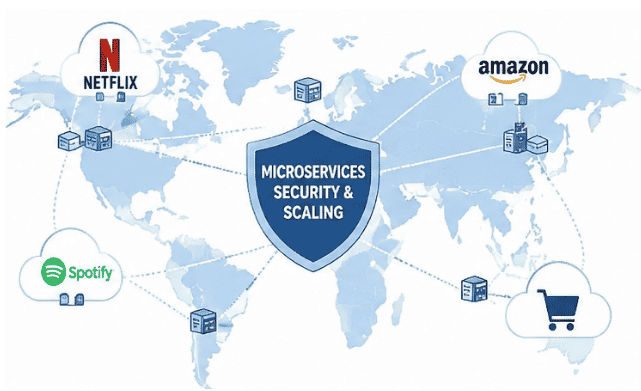
👉 Each service scales independently
When to Use Monolith?
Use Monolith if:
You are building a small application
You are a beginner
You want faster development
You have a small team
When to Use Microservices?
Use Microservices if:
You are building a large system
You need high scalability
You have multiple teams
You expect high traffic and growth
FAQs (Frequently Asked Questions)
1. What is the main difference between Monolith and Microservices?
Monolith is a single application where all features are combined. Microservices split the system into independent services.
2. Is Microservices better than Monolith?
Microservices is better for large and scalable systems, while Monolith is better for small applications.
3. Why do companies use Microservices?
Companies use Microservices for scalability, flexibility, and independent deployment of services.
4. Can we convert Monolith into Microservices?
Yes, but it is complex. It requires breaking the system step by step into multiple services.
5. Which is easier: Monolith or Microservices?
Monolith is easier to learn and develop. Microservices require advanced knowledge of distributed systems.
6. Does Netflix use Microservices?
Yes, Netflix uses Microservices architecture to handle large-scale traffic and ensure system reliability.
Conclusion
Both Monolith and Microservices are important in software development.
There is no perfect architecture for every system.
Monolith is best for simple and small applications
Microservices is best for large and scalable systems
The key is to understand when to use what based on real-world needs.